
-
Email Us:
thomas@beardedplumber.com -
Email Us:
thomas@beardedplumber.com 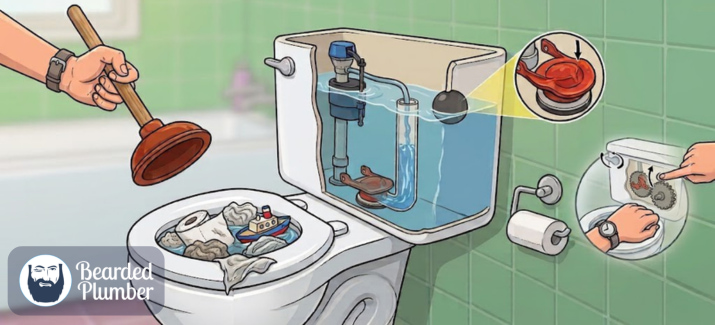
Have you ever sat quietly in your Tampa Bay home and suddenly heard your toilet turn on, run for a few seconds, and shut off? A few minutes later, it does the exact same thing.
You didn’t push the handle. Nobody is in the bathroom. Yet, the toilet seems to have a mind of its own.
Plumbers call this common issue “ghost flushing” or phantom flushing. While it might sound spooky, it is actually a standard mechanical issue. If you are wondering why my toilet keeps running on and off, the short answer is that water is slowly escaping the tank. Once the water level drops too low, the valve kicks on to refill it.
Left unchecked, a toilet that cycles on and off can waste hundreds of gallons of water every month. That means higher utility bills for your Tampa Bay home or commercial property. Fortunately, understanding why my toilet runs is straightforward, and the fixes are often simple.
To understand why does the toilet keep running, you first need to understand how the inside of the tank operates.
Your toilet tank holds a set amount of water waiting for the next flush. At the bottom of the tank sits a flexible rubber seal called a flapper. When you press the flush handle, the chain lifts the flapper. Water rushes from the tank to the bowl to clear out waste. Once the tank empties, the flapper settles back down over the drain hole, sealing it tight.
Next, the fill valve opens up to send fresh water back into the tank. A float device rises with the water level. When the water hits the proper height, the float shuts the valve off.
When a toilet keeps running on and off, this seal is compromised. Water drips continuously out of the tank down into the bowl. As the water level in the tank drops below a certain point, the float drops too. The valve thinks someone flushed, so it turns back on for a few seconds to top off the water. This cycle repeats all day and night.
If you are trying to figure out why is my toilet running constantly or cycling on and off periodically, check these four typical culprits.
The rubber flapper sits in water 24/7. Over time, rubber hardens, cracks, or warps. When the flapper loses its soft, flexible shape, it can no longer form an airtight seal against the flush valve opening. Water quietly trickles past the seal into the bowl.
Even if the rubber flapper is brand new, it needs a smooth surface to rest on. Minerals, algae, and chemical deposits can build up along the plastic flush valve seat. This rough buildup creates tiny gaps where water sneaks through.
The metal chain connecting your toilet handle to the flapper must have just the right amount of slack. If the chain is too short or tangled, it pulls upward on the flapper continuously. This stops the flapper from closing completely, allowing water to escape into the bowl.
Inside your tank is an open pipe called the overflow tube. Its job is to prevent water from spilling over the top of the tank onto your bathroom floor. If your float is set too high, the water level sits right at the top edge of the overflow tube. Small vibrations or slight pressure changes can cause water to continuously spill down the tube, triggering the fill valve to turn on again.
Homes and businesses across Hillsborough County, Florida, face a unique challenge: hard water. Water in the Tampa Bay area contains high levels of dissolved minerals, specifically calcium and magnesium.
Hard water speeds up plumbing issues in three distinct ways:
If you live in Tampa, Brandon, Riverview, or Plant City, you may need to clean or replace your toilet flapper more often than national averages suggest.
Before calling a professional plumber, you can run a quick diagnostic test yourself.
| Step | Action | Instructions |
| 1 | Add Dye | Remove the tank lid and drop 5–6 drops of food coloring into the water. |
| 2 | Wait | Do not flush the toilet for 15 to 20 minutes. |
| 3 | Check Bowl | Inspect the toilet bowl. If colored water appears, your flapper is leaking. |
A toilet that runs on and off can waste anywhere from 30 to over 200 gallons of water per day. In Hillsborough County, this leak can add tens or even hundreds of dollars to your monthly water bill if left unfixed.
It is rarely a structural emergency, but it is a financial waste. If you cannot turn off the water supply or if the toilet bowl is overflowing onto your floor, turn off the shutoff valve immediately and call a plumber.
Yes, basic valve replacement kits are available at local hardware stores. However, if your shutoff valve is old, corroded, or stuck, which is common in older Tampa homes, trying to force it can cause broken pipes and major indoor flooding.
If replacing the flapper did not stop the cycle, the issue is likely a malfunctioning fill valve, a cracked overflow tube, or an improperly adjusted float.
If you have tried adjusting the chain and changing the flapper, but why my toilet is constantly running remains an unsolved mystery, Bearded Plumber is here to help.
Our experienced, licensed plumbers serve residential and commercial property owners across Tampa and Hillsborough County. We quickly diagnose water leaks, upgrade failing fixtures, and ensure your plumbing runs efficiently. Contact Bearded Plumber today to schedule your service call!